Can you teach an old dog new tricks?
By Gomi's human — written from 11+ years alongside Gomi (@gomithesuperyorkie), not a vet's office · Last updated August 19, 2026 · about a 9-minute read
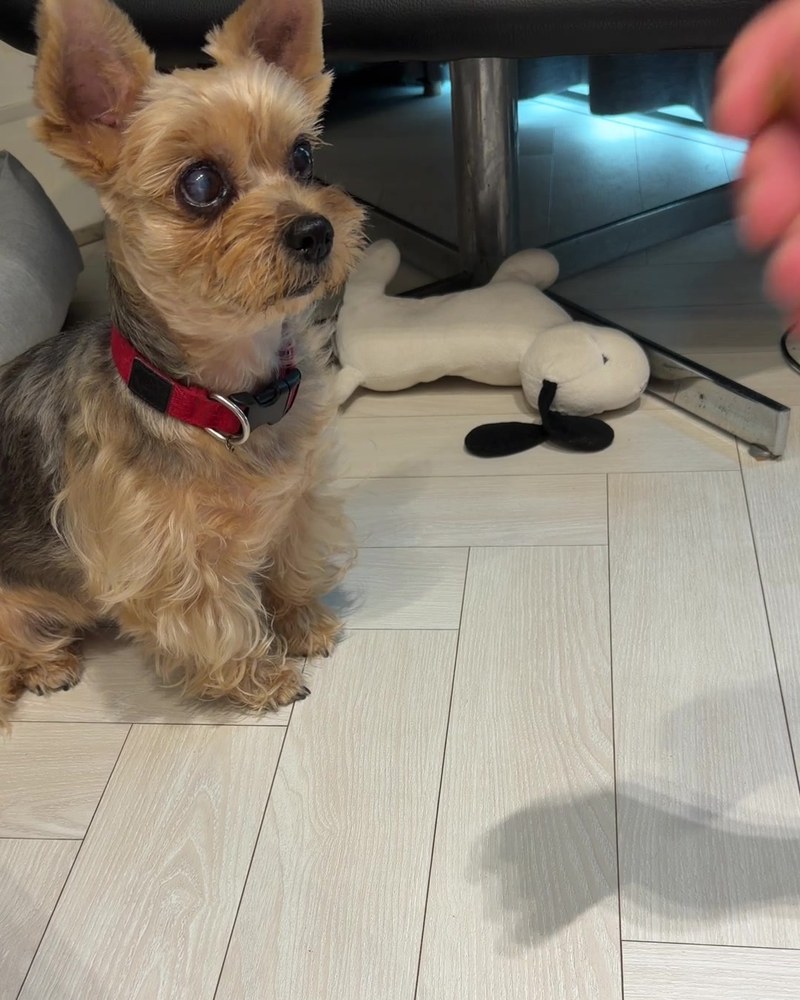
It's one of those sayings people repeat without ever having checked. You can't teach an old dog new tricks. It gets used about people more often than dogs these days, which tells you how thoroughly nobody has questioned the dog part. So here is the short version: it's wrong. And it's wrong in a more interesting way than you'd expect.
Part of our complete guide to caring for a senior dog.
What the research actually found
In 2016, researchers at the Clever Dog Lab in Vienna ran 95 Border Collies — ranging from five months to thirteen years old — through a series of touchscreen cognitive tests (Wallis et al., AGE, 2016). Three things came out of it, and only the first one matches the saying.
Older dogs learned more slowly. They needed more trials than younger dogs before they could solve a new discrimination task correctly. They were also less flexible — slower to abandon a rule once they'd learned it, and more stubborn about applying what they already knew.
Their memory didn't decline. When the dogs were retested on the same images six months later, there were no significant age differences. Whatever the old dogs had learned, they still had it half a year later.
And on logical reasoning, the older dogs won. On a task requiring inference by exclusion, the older the dog, the better it performed — while the youngest dogs couldn't master it at all. The researchers put this down to the same stubbornness that slowed their learning: older dogs lean harder on what they already know, which is a handicap when the rules change and an advantage when the answer has to be reasoned out.
So the accurate version of the saying is much less catchy. You can teach an old dog new tricks. It takes more repetitions, she'll be slower to unlearn the old way, she'll remember it just as long, and she may well out-think a puppy while she's at it.
The first thing Gomi learned at eleven wasn't a trick
It was holding still for eye drops.
She's on eye medication for life now — the long version of that story is here — and at the start she hated it. She ducked, turned her head, and backed away the moment the bottle appeared, four times a day. I was chasing a small unhappy dog around the room.
What changed it was not better technique. It was making the bottle reliably predict something good. Every single session ends with a treat, not sometimes, not if she was good. Every time. She stands still for it now, because as far as she is concerned the drops are the boring bit immediately before the snack.
That is a learned behaviour, acquired at eleven, held for months. It looks like nothing. It is the same mechanism as any trick, and it happens to be the one that made her life materially easier. Which is a decent argument for teaching an older dog the useful things first.
What changes when the student is old
The learning still works. The body around it is different, and so is the sensory equipment. Five adjustments cover most of it.
- Shorter sessions, more of them. Two or three minutes, once or twice a day. Older dogs need more total repetitions, which is an argument for frequency rather than length. A ten-minute session with a senior mostly teaches her that training is tiring.
- Hand signals before you need them. If hearing is starting to go, teach the visual cue alongside the spoken one now, while she can still hear you explain it. A dog who is already fluent in hand signals barely notices going deaf.
- Low-impact movements only. No jumping, no repeated sit-to-stand drills on slick floors, nothing that loads a sore joint over and over. If your dog is already hesitating at the stairs, that's worth reading about separately before you add repetitions to her day.
- Use the nose. Of everything that ages, scent holds up best. A dog who can no longer see the ball across the lawn can still find it by smell, and will be delighted to.
- Stop while she still wants more. This is the single most useful rule and the hardest to follow, because the moment it starts going well is exactly when you want one more rep.
Ten things worth teaching a senior dog
All of these are low-impact, most of them are genuinely useful, and none of them require an athletic dog.
- Nose touch. She boops your open palm on cue. Sounds pointless, is the single most versatile behaviour on this list — you can use it to move her, position her, or get her attention without touching her.
- Chin rest. She lays her chin in your cupped hand and holds. This is the foundation of every cooperative-care behaviour there is.
- Find it. Toss a treat into the grass or hide one under a cup. Pure scent work, zero joint load, and mentally tiring in the good way.
- Go to your mat. A named place she goes to and stays on. Useful every time the doorbell rings for the rest of her life.
- Look at me. Eye contact on cue. Costs nothing physically and gives you a way to reach her in a distracting moment.
- Paw or shake. Old, unglamorous, and a gentle way to get her used to having her feet handled before nail trims.
- Spin, slowly. A wide, gentle circle following a lure. Good for flexibility if her vet is happy with it — skip it if she has any spinal or hip issue.
- Back up one step. Two or three steps backwards, no more. Surprisingly good body awareness work.
- Put it in the basket. She drops a toy into a box. Two behaviours chained together, and it makes people laugh.
- Her own name, again. If she's started ignoring it, it isn't defiance — it's often hearing, or a name that has been used too often for things she didn't enjoy. Rebuild it with food and it comes back.
The method is the same for all ten. Lure the movement with food, mark the instant it happens with a consistent word, pay immediately, and only add the cue word once she is offering the behaviour reliably. One new criterion at a time, and never two.
A gentle bucket list
Somewhere along the way the phrase "bucket list" got attached to skydiving, and it does not translate well to a dog with stiff hips. A senior dog's list is not about intensity. It's about attention — doing ordinary things deliberately, while there is still time to do them.
Ours looks something like this, and yours will look different:
- A field she's never smelled before. Not a long walk. A new patch of ground and twenty unhurried minutes to read it.
- One meal that breaks the rules. Cleared with your vet, and worth the fuss.
- A car ride with the window down, going nowhere in particular.
- Proper photographs. Not phone snaps in bad light — actual portraits, taken on purpose, while she still looks like herself.
- A paw print or a nose print. Ink and paper, ten minutes, and you will be glad of it later than you think.
- A morning with nowhere to be. Sun on the floor, both of you doing nothing.
- A new trick, learned at ten or eleven. Because you can, and because the day she learns it is a good day.
- Her favourite person, invited over on purpose. Dogs have favourites. Ask her.
- The old game, played gently. Whatever she loved at three, adapted to what she can do at eleven.
- Written down. The things she does now that she won't always do. This is the one people skip and regret.
That last one is why this site exists at all. Our 90-day memory and care journal has pages built for it, and the free Tiny Changes checklist is a shorter place to start tonight. If you want the longer story of why I began writing any of it down, it's here.
Frequently asked questions
Is it too late to start training a ten-year-old?
No. It will take more repetitions than it would have at two, and she'll be slower to drop habits she already has. But she'll retain what she learns — the Vienna study found no age-related decline in long-term memory at a six-month retest.
What if she already knows the trick badly?
That's the genuinely harder case. Older dogs are less flexible about changing a learned rule, so re-teaching a sloppy behaviour takes longer than teaching a new one. Often it's easier to build a fresh behaviour with a fresh cue than to renovate the old one.
Should I use treats with an overweight senior?
Yes, but subtract them from her meals rather than adding them on top, and break them small — a pea-sized piece pays exactly as well as a large one. Weight is one of the biggest levers on an older dog's comfort, so it's worth doing the arithmetic.
She just seems tired. Is training unkind?
Two or three minutes of easy, well-paid work is closer to enrichment than exercise, and most dogs finish a session more settled than they started. But tiredness that's new, or that doesn't lift, is worth a conversation with your vet rather than a training plan.