Senior dog struggling with stairs?
By Gomi's human — written from 11+ years alongside Gomi (@gomithesuperyorkie), not a vet's office · Last updated August 12, 2026 · about a 6-minute read
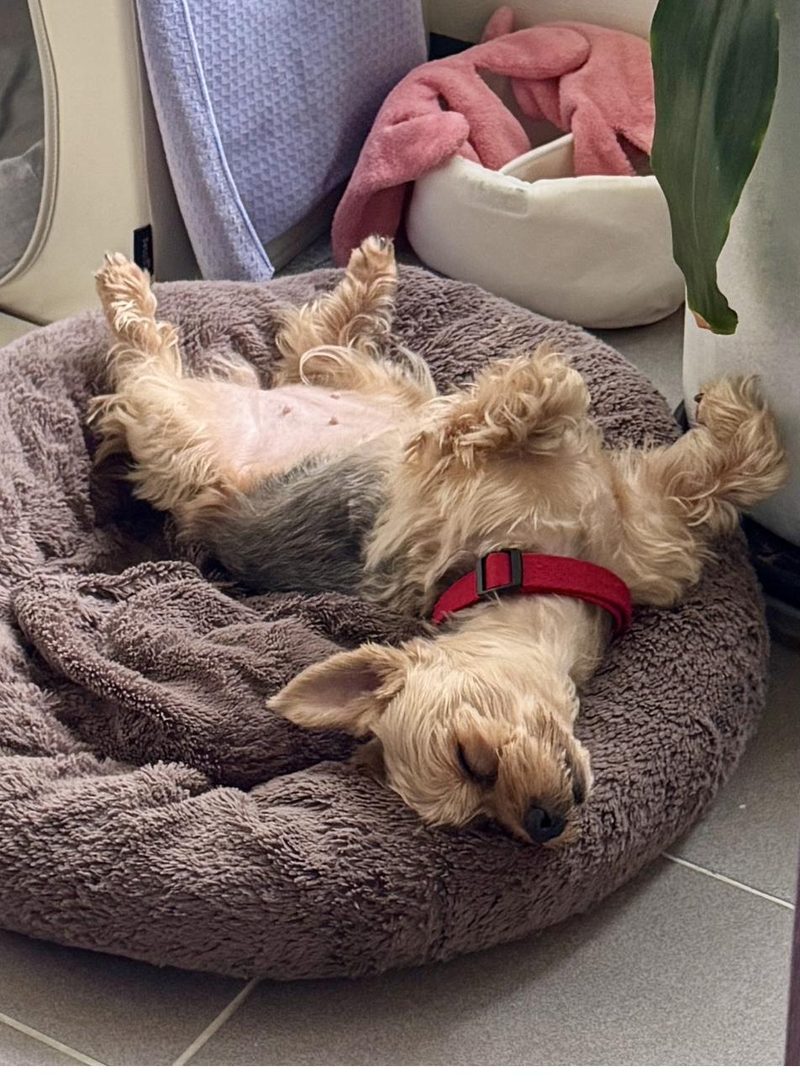
One day your dog stops at the bottom of the stairs. Not refusing exactly — just waiting, gathering herself, taking them one at a time instead of two. It is easy to file that under "she's getting older." Often it is the earliest thing you can actually see of a problem that has been building quietly for a year or more.
Part of our complete guide to caring for a senior dog.
Why stairs are usually the first thing to go
Flat ground is forgiving. A dog with a sore joint can shorten her stride, shift weight to the other side, and walk down the hallway looking more or less normal. Stairs remove those options. Every step demands a full range of motion in the hip and knee going up, and a controlled brake through the shoulder and elbow coming down, on one leg at a time, with the dog's whole body weight behind it.
That is why stairs — and the jump onto the couch, and the step up into the car — tend to break first. They are the movements with no way to cheat. By the time a dog is limping on a walk, she has usually been avoiding the stairs for months.
It also explains a pattern owners often find backwards: many older dogs will climb up willingly but hesitate coming down. Descending is braking work, and braking is done with the front end. If your dog charges upstairs and then stands at the top looking at you, the discomfort is more likely in the shoulders or elbows than the hips.
It is probably not "just old age"
Here is the uncomfortable arithmetic. In a study of 1,873 dogs over eight years old, radiographs found osteoarthritis in 40.3% of the joints examined, with the elbow the most affected at 57.4% (Roitner et al., The Veterinary Journal, 2024). Many of those dogs had come in for reasons that had nothing to do with their joints.
Now compare that with how often it gets diagnosed. Across 455,557 dogs under primary veterinary care in the UK, the annual recorded prevalence of appendicular osteoarthritis was 2.5%, and the median age at first diagnosis was 10.5 years (Anderson et al., Scientific Reports, 2018).
The gap between those two numbers is not a medical mystery. It is us. Joint pain in dogs does not look like pain — it looks like a dog who has calmed down, who naps more, who has stopped bothering with the ball. There is no yelp to react to, so nobody books an appointment, and the first diagnosis lands at ten and a half years old, well after the thing began.
None of which means your dog definitely has arthritis. It means "she's just old" is a conclusion for your vet to reach after looking, not a reason to skip looking. If you are unsure where your dog sits on the aging curve, our dog age calculator gives you a rough life stage in a few seconds.
What early joint trouble actually looks like
Rarely a limp. Much more often, a shrinking list of things your dog used to do without thinking:
- A pause at the bottom or top of the stairs before committing.
- Taking stairs one at a time, or leaning into the wall on the way down.
- No longer jumping onto the couch, the bed, or into the car — or trying, and aborting.
- Slipping on hard floors, with legs sliding outward on tile or laminate.
- Stiffness that fades. Worst on the first walk of the morning or after a long nap, better once she's moving.
- A changed resting position — sleeping on one side only, or taking longer to settle and to get back up.
- Licking one joint repeatedly, often a wrist or a knee.
- Turning around sooner on the usual walk, or lagging on the way home rather than the way out.
- Being touchy about being lifted, brushed, or handled in one spot.
Weather-sensitive stiffness — noticeably worse on cold or damp mornings — is worth writing down too, because it is a detail your vet can use and one you will not remember accurately three weeks later. Appetite changes can travel with pain as well; if that is happening, our piece on why senior dogs stop eating covers it, and the broader senior dog signs checklist puts mobility alongside everything else worth watching.
Six things you can change at home this week
None of these treat the underlying problem. All of them reduce how much it costs your dog to get through a normal day, and you can do them before the appointment.
- Put traction where she walks. Runners, yoga mats, or rubber-backed rugs along the hallway and at the top and bottom of the stairs. Slick floors make a dog brace, and bracing hurts.
- Remove the jumps. A ramp or a set of pet steps at the couch and bed takes out the single highest-impact moment in her day. The landing is the part that does the damage.
- Raise the food and water bowls. Chest height spares a stiff neck, shoulders, and elbows at every meal.
- Keep nails short. Long nails change how the paw meets the floor and cost her grip exactly where she needs it.
- Warm, supportive, easy-in bed. Off the draft, low enough to step into, thick enough that she is not resting a hip on the floor.
- Two short walks instead of one long one. AAHA's owner guide on mobility suggests exactly that kind of regular, moderate, split activity rather than weekend bursts (AAHA, Mobility Matters).
What only your vet can do
Three things, and they are the three that matter most.
Find out what it actually is. Stair reluctance can be arthritis, but it can also be a disc problem, a cruciate tear, a neurological issue, or referred pain from somewhere else entirely. Those are managed very differently, and telling them apart takes hands on the dog and usually radiographs.
Set a weight target. Weight is the single lever with the largest effect on joint load, and it is free. A vet will give you a number and a plan instead of a guess.
Prescribe pain relief. There is genuinely effective medication for canine joint pain, and it changes dogs' lives. It has to come from a vet.
Write it down before you go
The appointment goes better with specifics. "She's slowed down" gives your vet almost nothing. "Since June she stops at the bottom of the stairs about half the time, it's worse before breakfast and on cold mornings, and she hasn't jumped on the couch since May" gives them a timeline, a pattern, and a starting point.
For a week, note the date, which movement she avoided, the time of day, and the weather. That is it. Our 90-day memory and care journal has the daily pages built for this, and the free Tiny Changes checklist is a shorter place to start if you just want something on paper tonight.
There is a version of this where you notice at nine instead of twelve, and your dog gets three easier years out of it. That is the whole reason to pay attention to a pause on the stairs. If you want the longer version of why I started writing any of this down, it is here.
Frequently asked questions
Why is going down harder than going up?
Down is braking, and braking runs through the shoulders and elbows. Up is powered by the hind legs. A dog who climbs willingly but stalls on the descent is often pointing at her front end — and the elbow is the joint most frequently affected in older dogs.
She's slower, but she doesn't seem to be in pain. Isn't that just aging?
Slowness and reluctance are different things. A dog who wants to follow you and then stops is being stopped by something. Dogs do not show chronic pain the way we expect them to; they show it by quietly dropping activities. That is exactly why so much joint disease goes unrecorded until a dog is over ten.
Do joint supplements help?
Evidence varies a lot by product and by dog, and supplements are not a substitute for a diagnosis or for prescribed pain relief. Ask your vet before adding one, especially if your dog is on other medication.
Should I carry her up and down instead?
For a steep flight or a small dog, carrying can be a reasonable convenience. As a full replacement for movement it backfires, because she loses the muscle that protects the joint. Better to make the stairs safer and keep her using them if your vet agrees she should.