Why I started writing things down
By Gomi's human — eleven years alongside Gomi (@gomithesuperyorkie) · August 6, 2026 · about a 7-minute read
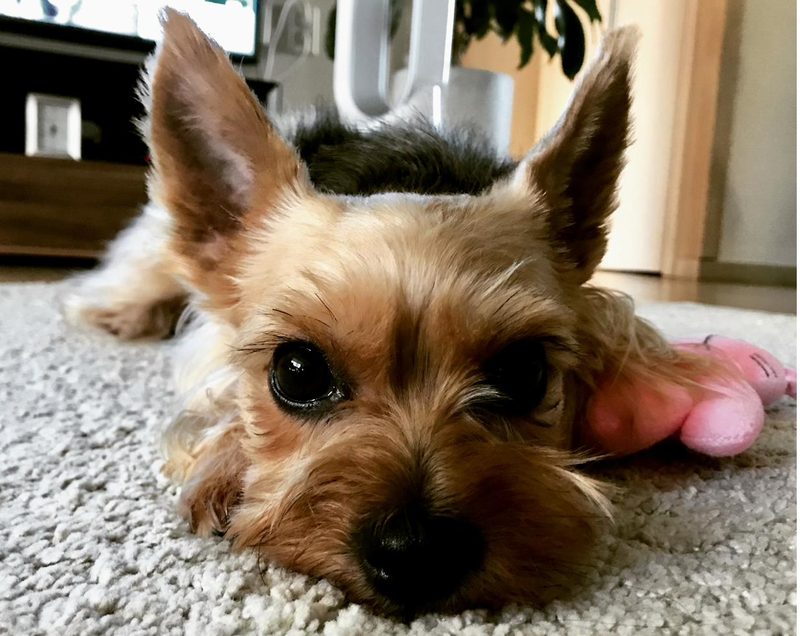
Gomi has lived in my house for eleven years. I only started paying attention a year ago.
My father was a dog person, so I grew up in a house that always had dogs in it. The big ones stayed out in the yard. Inside, there was a Chihuahua called Tico.
Tico had a puppy. We named her Soon-i, and from the beginning she was mine in a way nobody had to explain. She followed me and not my brothers. She came when I called and ignored everyone else. I don't know how that gets decided between a child and a dog, but it was decided early, and I loved her the way children love things — without reservation and without any sense that it could end.
Tico passed away first. Soon-i wasn't a year old yet.
Then one afternoon she slipped out into the yard, and one of the big dogs, a Jindo, got to her. Her back legs stopped working. We drove her to the animal clinic the same day.
I was a child, so what I have left is fragments. She was given an injection. Some minutes later she started foaming at the mouth, went into shock, and we lost her right there on the table.
I'm an adult now, and I understand that emergencies are full of things nobody chooses and nobody can undo. I'm not writing this to assign fault. It was a lifetime ago and I have no accusation to make. I'm writing it because I want to be clear about what a child does with something he can't process.
What I did was make a rule.
Every dog we had went off to my grandmother's place in the countryside, and I told myself I was finished. No more dogs in my house. Not ever.
I kept that rule for about thirty years.
The dog I agreed to
Then my daughter wanted one.
She wanted it the way children want things — completely, with no fallback position, with no interest in my reasons. I had no intention of saying yes. Thirty years is a long time to be sure about something. But there comes a point where you stop arguing with your own child about the shape of her childhood.
So eleven years ago we brought home a Yorkshire Terrier and called her Gomi.
She grew into an unusually large Yorkie — a solid eleven pounds — and she was so relentlessly alive that we started calling her Gomi the Super Yorkie, and it stuck.
She was my daughter's dog. That was the arrangement, and it suited me exactly. I fed her, I walked her, I was fond of her roughly the way you're fond of a houseguest who's staying a while. My daughter ran the Instagram account. My daughter shot the YouTube videos. I stayed a step back, and I want to be honest — I stayed there on purpose.
Then my daughter left to study abroad, and Gomi stayed.
Here is the part that doesn't flatter me. Gomi became my dog, and I stopped posting. The Instagram went quiet. The videos stopped. I told myself I was busy.
I've had a year to think about that and I don't believe I was busy. I think some part of me knew that recording a dog is a way of admitting out loud that you love her, and I had spent three decades declining to do that.
She was beautiful, and she was better than beautiful. She is the kindest animal I have ever known. In eleven years she has not once bitten a person. She likes everyone, immediately, with no conditions and no warm-up period, and there is nothing mean in her anywhere. I have never met another dog like her.
I knew all of it the whole time. I simply made a habit of not looking straight at it.
The day she walked wrong
A year ago Gomi spent a few days at my mother-in-law's house. By every report she was fine — eating, playing, entirely herself.
She came home and crossed the floor wrong.
That was the whole signal. No crying, no collapse, nothing you could point at. Her gait was slightly off in a way I noticed and couldn't account for. We were at the hospital that afternoon.
It was pyometra — an infected uterus — and it was an emergency. They operated the same day. Afterward the surgeon told me that if we had waited, it could have gone very differently.
I brought her home and sat down on the floor and looked at her, and the thought came in fully assembled. I could have lost her. Not eventually. That week.
And directly underneath it: what am I going to do when she's gone?
A year of looking
Recovery was slow. Then an eye problem arrived that never entirely cleared, and I began treating her eyes every morning. That was a year ago. I still do it every morning and I expect I always will.
If you've done this, you know what it costs you. You hold the dog's face steady. You look directly into her eyes from a few inches away. Then you do it again tomorrow, and the day after, for a year and counting.
I had lived with this dog for ten years and I had never actually looked at her.
She looked back like a person. That's the closest I can get to describing it. Something was in there, meeting me.
Something else changed over those months. She got affectionate — suddenly, dramatically more affectionate than she had been in a decade. I don't know what she understood about having been sick. But she kept moving closer, and closer, and eventually I stopped keeping the distance.
What I mostly felt, sitting there with her, was that I had wasted time. Ten years with a dog I loved and wouldn't say so, because of something that happened to a boy a lifetime ago.
What I started writing down
The eye treatment is what taught me to notice, and noticing turned into writing.
It started as nothing. Notes in my phone, dated, a line or two. Ate slowly this morning. Took the stairs without stopping. Slept through the delivery guy, which is new. I told myself it was medical — that I was building something useful to hand the vet at the next visit. Some of it was.
But when I read those notes back a few months later, the lines I stopped on weren't the medical ones. The vet notes told me facts I could have gotten from a chart. The lines that stopped me were the other kind. She waited at the top of the stairs for me instead of going down first. She has started doing this. Sat in the one patch of sun on the kitchen floor for forty minutes. Barked at the neighbor she has not barked at once in eleven years.
Those were the days themselves. And I noticed something uncomfortable about them: the ones I had written down, I still had. The ones I hadn't were simply gone. Not blurry — gone. Ten years of ordinary afternoons I could not retrieve in any form.
That is what the journal came out of. Ninety days of prompts, some of them practical — energy, appetite, sleep, movement, the small changes worth noticing in an older dog — and a lot of them not practical at all. What did she do today that was completely her. What are you going to want back in five years. What have you never written down because it happens every single day.
People sometimes assume a journal like this comes out of grief. It didn't. It came out of the reverse.
Gomi is eleven and heading toward twelve. She limps some days. She rests considerably more than she used to and she takes the stairs at her own pace and she is still, unmistakably, herself. Our days are ordinary. That is the entire point. Ordinary is the part you lose.
What I'd say to you
I'm not writing this to tell you to keep a journal. I made one, and I'll tell you about it another time.
I'm writing it for anyone who is holding back on purpose. Anyone with an older dog who has quietly started protecting themselves in advance — looking a little less, photographing a little less, staying half a step back, because you can already see the ending from where you're standing.
I did that for ten years. I can tell you what it buys you, which is nothing. It doesn't make the ending easier. It only takes the middle away.
Look at your dog today, while it's still boring.
— Gomi's dad. She's still the Super Yorkie, eleven years in.
If you're not sure where your dog is in all of this, the dog age calculator is a place to start, and the senior dog care guide covers what tends to change and when.