Senior dog eyes — cloudy, weepy, or just older?
By Gomi's human — written from 11+ years alongside Gomi (@gomithesuperyorkie), not a vet's office · Last updated August 19, 2026 · about an 8-minute read
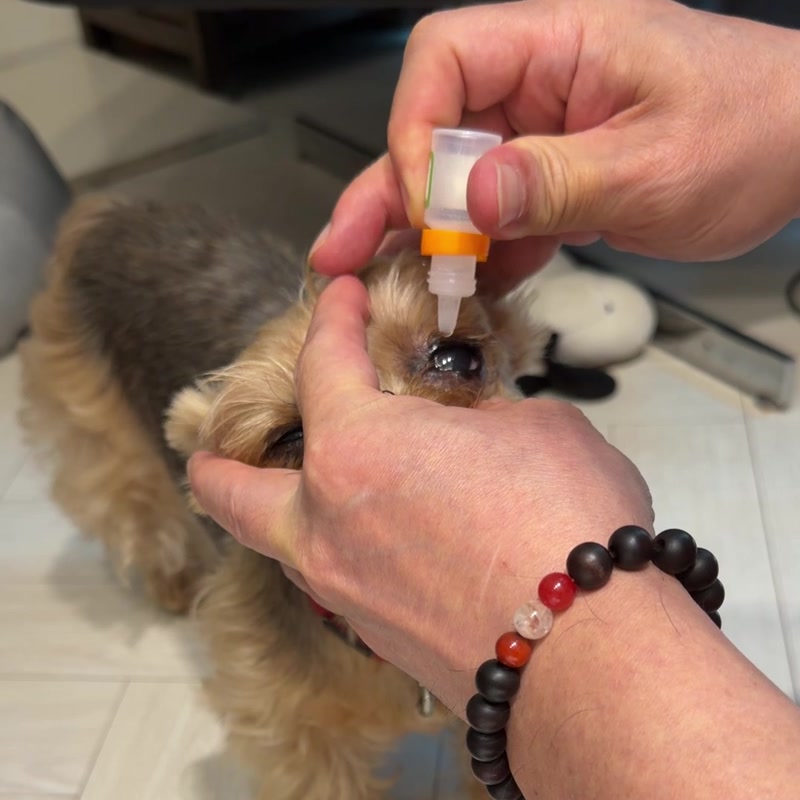
Gomi's right eye went red. Then it stayed red. Over the next six months I took her to six different clinics and got the same answer at every one of them — inflammation — and the same treatment, which was antibiotics. Nobody was careless and nobody was unkind. The eye just kept being red.
Part of our complete guide to caring for a senior dog.
The thing six vets didn't see
At the seventh clinic, a vet spent a long time actually looking — properly, with the lids held back and a light. There was a worm in her eye.
Thelazia callipaeda, the oriental eyeworm, lives in the conjunctival sac. The Merck Veterinary Manual describes it as an emerging zoonotic parasite spread by fruit flies of the genus Phortica, whose males feed on tears, and it is now reported across Europe, Asia, and the United States. In dogs it causes watering, itching, conjunctivitis, and keratitis with corneal opacity and ulcers. In other words, it produces exactly the picture that six competent people had reasonably called inflammation.
The worms were treated and they went. But by then the eye had spent half a year inflamed, and eyes remember that.
I am not telling this story to say your vet is missing something. I am telling it because of what it taught me, which is the only piece of this article I would want you to keep if you kept nothing else. An eye problem that is not getting better is itself information. Weeks of treatment with no change does not mean try the same thing for longer. It means the working theory may be wrong, and it is entirely reasonable to say so out loud and ask for a referral to a veterinary ophthalmologist. I waited six months to say it. I would not wait that long again.
"Cloudy" is three different things
After the worms were gone, both of Gomi's eyes looked hazy. This is the part where most owners, me included, say the word cataract and feel their stomach drop. It is worth slowing down there, because a cloudy-looking eye in an older dog can be at least three separate things, and they behave nothing like each other.
- Nuclear sclerosis — an age change inside the lens, where the fibres compress over time. The American College of Veterinary Ophthalmologists notes it is often seen after 8 to 10 years of age and "is not thought to cause any significant vision impairment in our pets." It looks like a faint blue-grey haze deep in the eye. Nothing reverses it, and for most dogs nothing needs to.
- A cataract — a true opacity of the lens, which can be inherited, metabolic (diabetes is a common driver), traumatic, or age-related. A mature cataract affects the whole lens and causes real vision loss. This one matters, and it is the one worth catching early.
- Something on the cornea — the clear window at the front. Swelling, scarring, pigment, or an ulcer all read as white or grey to the naked eye. Unlike the lens changes, corneal problems often do respond to treatment, which means they can get better and they can get worse.
They look similar from where you are standing, and ACVO is blunt that telling them apart takes a proper ophthalmic exam, usually with the pupil dilated. You cannot do it from the sofa and neither can I.
What happened with Gomi is that some of the whiteness cleared as the eye healed and some of it did not. The part that cleared was the part that could — surface damage, settling down. What is left is what our vet calls nuclear sclerosis, and the honest version is that it is not going anywhere. Her left eye looks clear now. The right one carries a faint haze, and we manage around it rather than expecting to fix it.
What the daily drops are actually for
Gomi is on eye medication for life now. Anti-inflammatory drops, a saline rinse for the discharge, and a lubricating ointment for dryness. It is four rounds a day and I do not always love it.
For a long time I thought of all of it as "treating the cloudy eye," and that was the wrong model. Drops and ointment cannot reach into the lens. What they protect is the surface — the tear film and the cornea. That is not a consolation prize. The tear film is what keeps the cornea comfortable and clear, and when it fails, the eye develops thick discharge, a dull dry look, redness, squinting, and in chronic cases blood vessels or dark pigment creeping across the cornea, according to Cornell's Riney Canine Health Center. That kind of dry eye is diagnosed with a Schirmer tear test and a fluorescein stain, it is not curable, and it is managed for life.
So the reframe that helped me was this. The daily routine is not slowing down the haze in the lens. It is holding the line on everything in front of the lens — and that is the part where daily effort genuinely changes the outcome.
How to give a dog eye drops without a wrestling match
The mechanics first, then the part that actually made the difference.
- Clean first. VCA suggests gently clearing debris from around the eye with warm water and a washcloth before anything goes in. Wipe from the inner corner outward, and use a fresh area of cloth for the second eye.
- Come from behind, not from the front. A bottle descending toward a dog's face is alarming. Standing beside or slightly behind her, with her head steadied from underneath, is not.
- Anchor your hand to the dog. Rest the heel of the bottle hand against her head so that if she moves, the bottle moves with her. This is the single change that made me stop being nervous.
- Pull the lower lid down slightly and aim for the inner corner. Cornell's guidance is to squeeze the drop into the inner corner and then hold the head up for a moment so it spreads across the surface.
- Never let the tip touch anything. Not the eye, not the lids, not the fur, not the counter. Cornell adds that with ointment you should point the tube tip away from the eye, so a sudden jerk cannot drive it into the surface, and lay the ribbon along the inside of the lower lid instead.
- Ask about order and spacing. If your dog is on more than one product, ask your vet which goes first and how long to leave between them. It matters, and the answer depends on what you have been given, so I am not going to invent a number here.
The part that changed everything: pay her
For the first stretch, Gomi hated this. She would duck, turn her head, and back away when she saw the bottle, and I was chasing a small, unhappy dog around the room four times a day.
What fixed it was not better technique. It was making the drops reliably predict something good. Every single session ends with a treat — not sometimes, not if she was good, every time. She now stands still for it, because as far as she is concerned the eye drops are the boring bit that comes immediately before the snack.
This is not a trick I invented. The 2015 AAHA Canine and Feline Behavior Management Guidelines put it plainly: behaviors that are rewarded are repeated and increase in frequency. The guidelines describe counterconditioning and desensitization — changing what a dog expects from a situation, and rewarding calm rather than punishing struggle — and they make the point that the time to teach an animal to accept medication is before you need it rather than in the middle of a crisis.
A few things that helped us:
- Same place, same order, every time. Predictability does a lot of the work.
- Pay for the setup, not just the finish. Early on, treat her for letting you hold her head, before any drop goes in.
- Keep the treat visible. Gomi can see where this is going, and that is the point.
- Stop while it's still going well. Ending on a good round is worth more than getting one extra dose in on a bad one.
- Don't apologize with your body. Tense, hesitant hands take longer, and longer is what she actually dislikes.
What to watch for between visits
Eyes change slowly, and slow changes are the ones you stop seeing because you look at them every day. The things worth writing down are these:
- Discharge that changes character — clear to thick, or yellow-green.
- Tear staining appearing or getting worse on one side.
- Squinting, blinking more, or holding one eye slightly closed.
- Pawing at the face or rubbing along furniture and carpet.
- New haze, especially if it looks like it sits on the front surface rather than deep inside.
- Bumping into things in dim light, or new hesitation on stairs and in unfamiliar rooms.
- A change in how the eyes look in photos — flash photos are an unreasonably good early record, and you already have hundreds.
If night-time confusion is part of the picture, it is worth reading around the subject rather than assuming it is the eyes; our senior dog signs checklist puts vision alongside the other changes worth tracking. Eyes and mouth also tend to slide at the same time in an older dog, and the same daily handling routine covers both — what senior dog bad breath means is the companion piece to this one.
For a proper record, our 90-day memory and care journal has daily pages built for exactly this kind of small-change noticing, and the free Tiny Changes checklist is a shorter place to start tonight. If you want a rough sense of where your dog sits on the aging curve, the dog age calculator takes a few seconds. And the longer story of why I started writing any of this down is here.
Frequently asked questions
My senior dog's eyes look cloudy. Is it cataracts?
Maybe, but the odds favour something more boring. Nuclear sclerosis is an age change in the lens, commonly seen after 8 to 10 years, and ACVO does not consider it a significant threat to vision. Cataracts are a genuine opacity and a mature one does take sight. Corneal problems look white too. Only an exam separates them.
Can drops clear a cloudy lens?
No. Nothing you put on the surface reaches the lens. Drops and ointment protect the tear film and cornea, which is a different job and a worthwhile one.
How often should an older dog's eyes be checked?
At minimum, whenever the rest of the dog is being checked — and many vets see senior dogs every six months. If your dog is already on eye medication, your vet will set the interval, and it will usually be shorter.
Is it normal for an old dog to have more eye discharge?
Common, but not something to file under normal without a look. Persistent thick or yellow-green discharge is one of the signs Cornell lists for dry eye, which is diagnosed with a simple tear test and managed for life. It is an easy thing to test for and a bad thing to ignore.