Dog dementia signs, and what they usually turn out to be
By Gomi's human — written from 11+ years alongside Gomi (@gomithesuperyorkie), not a vet's office · Last updated August 24, 2026 · about a 10-minute read
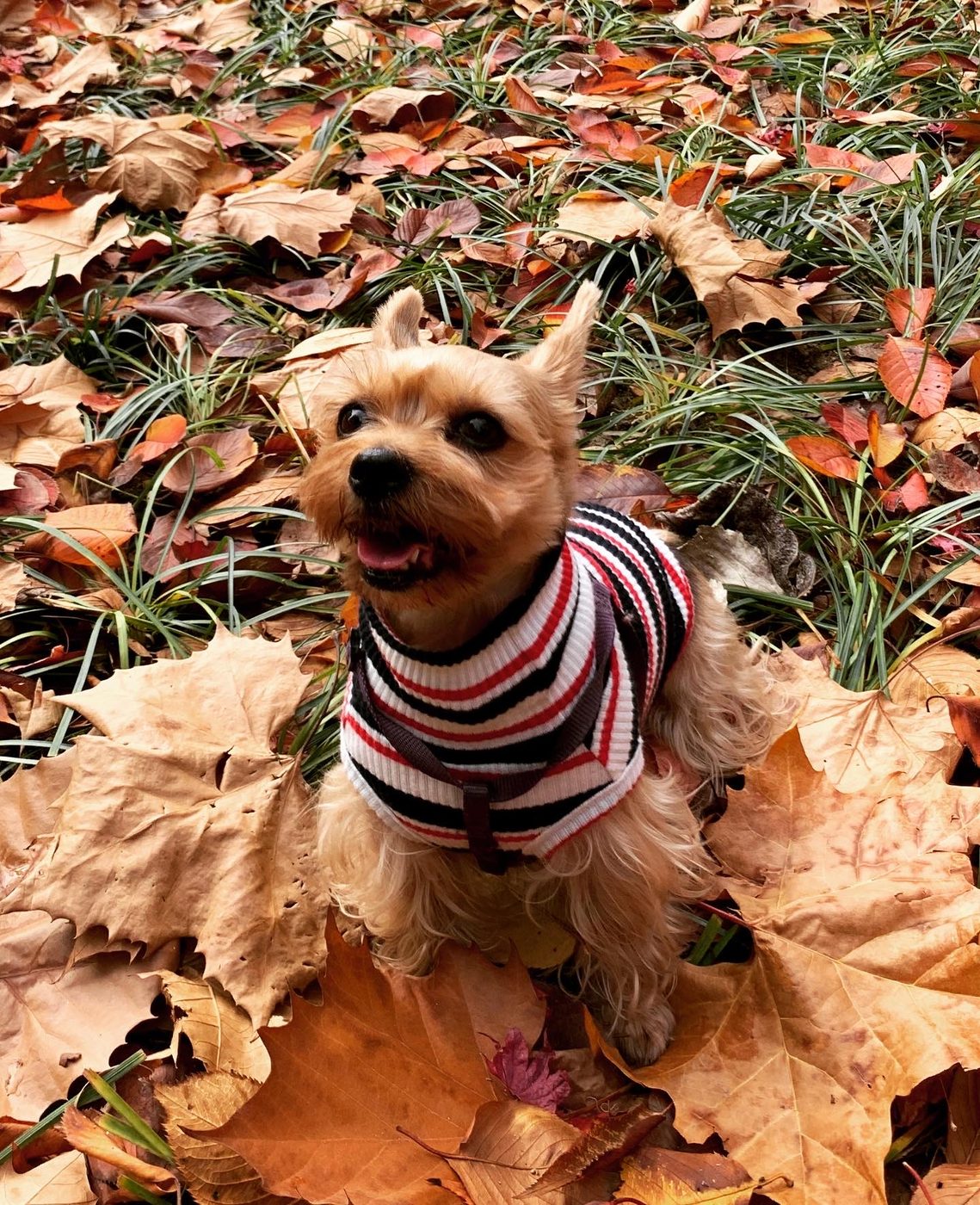
A few weeks ago I took Gomi down to the river before dawn. There was nobody around, so I let her off the lead, which I almost never do. I walked ahead maybe ten metres and stopped. Normally she knows exactly where I am. This time I turned around to find her looking left, looking right, scanning — and then she took off at a run in completely the wrong direction. I shouted her name, she froze, and she came back. It lasted about eight seconds. It had never happened before in a year of the same walk, and I have thought about it most days since.
Part of our complete guide to caring for a senior dog.
If you searched for dog dementia signs, you probably have your own version of those eight seconds. So this article does two things in order. First, the six categories that vets actually screen on, because vague worry is hard to act on. Then the more useful half — why the same six categories are far more often produced by eyes, ears, pain, or kidneys than by a failing brain, and how to tell your vet the difference.
Dementia in dogs is a diagnosis of exclusion
This is the part that reframes everything else, so it goes first. There is no blood test for canine cognitive dysfunction and no scan that shows it. It is diagnosed by ruling other things out.
The 2023 AAHA Senior Care Guidelines say that "a thorough history, physical examination, neurological examination, biochemical evaluation, and urinalysis are integral to ensure these animals do not have other underlying disease causing similar clinical signs," and they name three culprits directly: intracranial neoplasia, pain, and organ dysfunction.
Read that as a promise rather than a hurdle. Almost everything on the exclusion list is more treatable than dementia. The owner who walks in saying "I think she's losing her mind" and walks out with a urinary tract infection or an arthritis plan has had a very good day.
The six categories, with an honest example of each
The screening framework most commonly used is DISHAA — six letters for six areas of behaviour. I have put Gomi against each of them, because a list of symptoms in the abstract is much less useful than a list you can see somebody actually applying to a real dog.
D — Disorientation
Getting stuck behind furniture or in corners. Standing on the hinge side of a door waiting for it to open. Staring at walls or into space. Getting lost in the house or the garden. Failing to recognise familiar people or other pets.
Gomi: the river, once, in a year. Nothing indoors, ever.
I — Interactions
This one moves in both directions and both count. Less interest in approaching you, greeting you, or being stroked. Or the opposite — new irritability, fearfulness, or snappishness with visitors, family, or other animals.
Gomi: she has become noticeably more affectionate over the past year, not less. She wants to be against me more of the time than she used to. I had filed this under "she's getting sweet in her old age," which is a sentence worth being suspicious of.
S — Sleep and waking
Pacing and restlessness, particularly at night. Waking more, sleeping less in the dark, vocalising in the small hours — and often sleeping more during the day to compensate. A reversed clock is one of the most reported early changes there is.
Gomi: yes, mildly, on both halves. She wanders around at night a little more than she used to, and it does not look like hunger. She also naps more in the daytime than she did a year ago.
H — House soiling, learning and memory
Indoor accidents in a dog who was reliable. No longer signalling to be let out. Slower or absent responses to known commands and to her own name. Harder to get her attention; more easily distracted.
Gomi: she used to hit the pee pad exactly. Lately she goes beside it, or half on it, more often than she used to. Her response to her name and to commands is completely unchanged.
A — Activity
Less exploring, less play, less interest in things she used to seek out. Or aimless activity replacing purposeful activity — circling, repetitive licking or chewing, staring at nothing.
Gomi: nothing here.
A — Anxiety
New or worse separation distress. Bigger reactions to noises and sights that never used to bother her. More fear of unfamiliar places or of going out at all.
Gomi: nothing clear, though this one overlaps with the clinginess above and I am not sure I could separate them honestly.
Now the part that changed my mind
Count Gomi's answers and you get changes in four of the six categories. On paper that is a dog whose owner should be worried.
Except that Gomi has an eye condition. She has been on daily drops for life since an eyeworm went undiagnosed for six months, her right eye is still slightly cloudy, and our vet calls it nuclear sclerosis. And the morning she could not find me by the river, it was before sunrise, she was ten metres away, and I was standing still and silent.
That is not a memory failure. That is an eleven-year-old dog with a compromised eye, in the dark, looking for a stationary object. The moment I let myself see it that way, the eight seconds stopped being frightening and started being information about her eyes.
The research supports being this suspicious. In the Dog Aging Project's cohort of 15,019 dogs, "dogs with a history of neurological, eye, or ear disorders had higher odds of CCD" even after controlling for age, breed type and activity level. A follow-up study of 11,574 dogs found sensory impairment associated with an odds ratio of 3.23 for crossing the cognitive dysfunction threshold.
There are two readings of that and both are true at once. Sensory loss may genuinely accelerate cognitive decline, because a brain with less coming in has less to do. But these scores come from owners answering questions about behaviour — and a deaf dog who does not come when called, or a half-blind dog who bumps into the coffee table, scores exactly like a confused one. The questionnaire cannot tell the difference. Your vet can.
What each of Gomi's four signs could be instead
- Missing me at ten metres in the dark — vision. Low light is where a cloudy or ageing eye fails first. More on that in senior dog eye care.
- Night pacing and daytime sleeping — pain is the classic mimic here. Dogs who cannot get comfortable get up, turn, lie down, get up again, and then catch up on sleep during the day. That is the whole subject of the seven subtle signs of pain. Full bladder, needing to go out more at night, and simple sleep-cycle drift also live here.
- Missing the pee pad — this is the one I would want checked properly. Urinary tract infection, kidney disease, endocrine disease and pain all cause it, and so does not being able to see the edge of a pad clearly in a dim hallway. It is also the one owners are most likely to write off as naughtiness.
- New clinginess — anxiety, discomfort, or reduced confidence in a dog who can no longer track where you are by sight. Being more affectionate is the pleasantest possible symptom, which is why it never gets reported.
None of that rules dementia out for Gomi. It reorders the questions. At her next check-up I am not walking in and saying "I think she has dementia." I am saying: night pacing has increased since roughly May, daytime sleeping is up, the pad accuracy has slipped, she lost track of me once in low light, and her recall and commands are unchanged. Those are five facts a vet can work with, and the last one — unchanged recall — is quietly the most reassuring thing on the list.
What is actually known about who gets it
Two numbers from the same 15,019-dog cohort are worth carrying around.
The first is age. "When controlling for all other characteristics, the odds of CCD increased 52% with each additional year of age." Dementia is not a thing that arrives; it is a slope, and every birthday moves you along it. This is the argument for building a written baseline while your dog is fine rather than after she isn't.
The second is activity, and it is bigger than I expected. "Among dogs of the same age, health status, breed type, and sterilization status, odds of CCD were 6.47 times higher in dogs who were not active compared to those who were very active." The follow-up study put the odds ratio for reaching the clinical threshold at 0.53 per unit of physical activity.
Now the honest caveat, which the authors state themselves: the study "cannot determine causality," and reverse causation has not been ruled out. A dog whose cognition is slipping may simply be doing less — the decline could be causing the inactivity rather than the other way round. Nobody should promise you that walks prevent dementia.
What I would say is narrower and still worth acting on. An active, mentally engaged old dog is a better outcome by every measure we can actually observe, whichever direction the arrow runs. AAHA's own management advice pairs diet with environmental enrichment — exercise, new toys, cognitive games, tasks. If you want the encouraging version of that, the learning research is genuinely good news: an old dog can still learn new things, and teaching her something is the cheapest enrichment there is.
Build the record before the appointment
Every sign in this article is a change from a baseline. If you cannot describe the baseline, the vet is working from adjectives.
- Score the DISHAA sheet today, even if everything is normal. A zero from this year is worth a great deal next year.
- Date the changes. "Since roughly May" is enormously more useful than "recently." Slope matters more than any single score.
- Film thirty seconds of the night behaviour if there is any. Nobody describes pacing accurately from memory, and your vet will never see it in the consult room.
- Separate the senses from the cognition. Test recall from behind her in daylight and again in dim light. Test her name from out of sight. Note which conditions the failures happen in — that is the single most useful thing you can bring.
- Write down what has not changed. An unchanged list is diagnostic information too, and it is the part everyone forgets to mention.
- Ask for the urinalysis if there are any house-soiling changes. Do not let that one get filed under behaviour.
Our 90-day memory and care journal has dated daily pages built for exactly this kind of slow-change tracking, and the free Tiny Changes checklist is a shorter place to start tonight. AAHA recommends a medical workup for senior pets once or twice a year including blood work and urinalysis — if you already have that appointment booked, the observations above are what make it count.
And if the reason you are reading this at midnight is that you are frightened of what is coming rather than dealing with something today, the longer story behind this site is closer to what you actually want.
Frequently asked questions
What are the first signs of dementia in dogs?
Usually a changed night — more pacing, more waking, less settling — with more daytime sleeping alongside it. Disorientation, changed social behaviour, house soiling, changed activity and new anxiety fill out the six screening categories. One sign in isolation rarely means much; several categories moving together is what starts a veterinary conversation.
How is canine cognitive dysfunction diagnosed?
By exclusion. There is no test for it. AAHA calls for a full history, physical and neurological examination, biochemistry and urinalysis to rule out other disease first, naming intracranial tumours, pain and organ dysfunction specifically.
Is it dementia or is she going blind or deaf?
This is the most common confusion, and you cannot settle it with a questionnaire, because questionnaires score behaviour. A dog who ignores her name may not have heard it. Test recall in bright light and dim light, in sight and out of sight, and take the pattern to your vet.
Is there a home test for dog dementia?
There is a free scoring sheet, which is not the same thing. The DISHAA Assessment Tool rates six categories from 0 to 3; 4 to 15 is mild, 16 to 33 moderate, above 33 severe. Use it to track change over time, not to reach a conclusion.
Does keeping my dog active prevent dementia?
The link is strong — odds of cognitive dysfunction were 6.47 times higher in inactive dogs than very active ones in a 15,019-dog cohort — but the researchers explicitly cannot rule out that declining dogs simply move less. Keep her active anyway; the case for it does not depend on this question being settled.