Senior dog bad breath isn't just dog breath
By Gomi's human — written from 11+ years alongside Gomi (@gomithesuperyorkie), not a vet's office · Last updated August 15, 2026 · about a 7-minute read
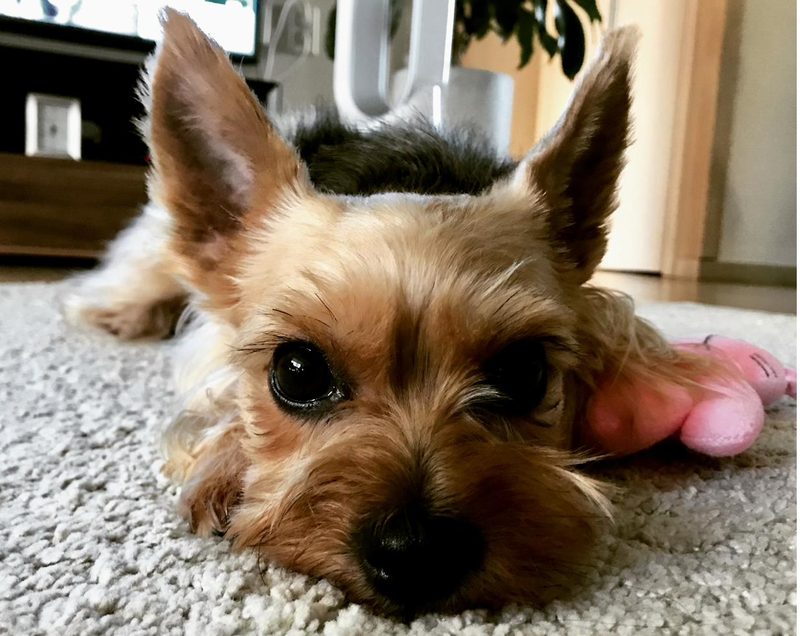
There is a thing people say about old dogs, and they say it kindly. Well, that's just dog breath. It gets filed next to grey muzzles and longer naps, as though a mouth that smells is simply what happens when a dog gets older. It isn't. In a healthy mouth, there is nothing there to produce that smell. When the smell arrives, something has changed.
Part of our complete guide to caring for a senior dog.
What the smell actually is
Bad breath is not a substance a dog produces. It is a by-product. Plaque forms on the teeth within hours, hardens into calculus if it isn't removed, and works its way under the gumline, where bacteria live in a place a toothbrush was never going to reach. Those bacteria release the sulphur compounds you smell. The odour is the exhaust, not the engine.
Which means the smell is a symptom, and a fairly late one. The WSAVA Global Dental Guidelines describe the sequence plainly: the first outward sign of gingivitis is reddening of the gums, followed by swelling and halitosis. But before any of that, there is bleeding at the gumline when the dog chews or is brushed. By the time you can smell it across the room, the process has been running for a while.
The same guidelines put the scale of it in one sentence. By two years of age, 80% of dogs have some form of periodontal disease, and they call it by far the number one health problem in small animal patients. Not the number one dental problem. The number one health problem.
That is why "just dog breath" became a saying in the first place. It is so common that it started to sound normal. Common and normal are not the same word.
The part I got wrong
Gomi is eleven, and her breath doesn't smell. I took that as a verdict. No smell, no problem — and if I'm honest, it was a convenient verdict, because I have never been good about brushing her teeth. She gets soft dental chews, she always has fresh water, and that was more or less the whole programme.
Here is the sentence that changed my mind, from those same WSAVA guidelines: periodontal disease is grossly underdiagnosed, mostly because there are few to no outward clinical signs, and the lack of these signs should not be misconstrued as evidence that there are no lesions or that they are not painful.
The 2019 AAHA Dental Care Guidelines attach a number to it. In one study, 28% of dog teeth that looked grossly normal turned out to have clinically important findings on dental radiographs. Nearly one tooth in four that passed inspection by eye had something going on that only an X-ray could see.
So a clean-smelling mouth is good news about the part you can see. It is not news at all about the part you can't. And the part you can't see is where periodontal disease lives.
What we did about it
Within the past year, Gomi had a dental appointment under anesthesia — a proper examination of the mouth plus a full set of dental X-rays. Everything came back clear.
I want to be careful about how I tell that, because it would be easy to turn it into a brag and it isn't one. She got lucky. A small dog, eleven years old, with an owner who was casual about brushing, is not a dog you would expect to come through clean. The reason I'm glad we went is not that the result was good. It's that before we went, I had no idea, and I would have kept not knowing indefinitely, because nothing about her was giving me a reason to look.
The anesthesia is the part most owners of older dogs get stuck on, and that hesitation is reasonable — it is the same instinct that makes you a careful owner in the first place. It is also the part worth having an actual conversation about rather than a private worry about. Pre-anesthetic blood work and a frank discussion of your individual dog's risks are the normal path here, and your vet has that conversation constantly. There is no version of this article where I tell you what the right answer is for your dog. There is a version where I tell you it's a question worth asking out loud.
What to watch for, beyond the smell
Dogs are unhelpfully stoic about mouth pain. They almost never stop eating, because the drive to eat outruns the discomfort — they just change how they eat. The signs are behavioural, and they are quiet:
- Chewing on one side, or tilting the head to work food toward one side of the mouth.
- Dropping kibble and picking it up again, or leaving the hard pieces at the bottom of the bowl.
- Preferring soft food when she used to eat anything.
- Blood streaks on a chew toy, in the water bowl, or on bedding after she's been mouthing something.
- A red line where the gum meets the tooth, or gums that bleed when touched or brushed.
- Turning her head away when you reach for her muzzle, or new sensitivity about being handled around the face.
- Pawing at the mouth, face rubbing along the carpet, or unusual drooling.
- Teeth chattering, which AAHA lists alongside halitosis, weight loss, and changed eating habits as indirect indicators of untreated dental pain.
- Slow weight loss with no obvious cause.
Two of those overlap with other things worth taking seriously. If eating itself is falling off, our piece on why senior dogs stop eating works through the wider list of causes, and the senior dog signs checklist puts mouth changes alongside everything else it helps to watch week to week.
What actually helps at home
Home care doesn't treat existing disease. It slows the accumulation that causes the next round, which over a dog's life is worth a great deal.
- Brushing, ideally daily. AAHA is blunt about the frequency: brushing needs to be done daily to be of benefit. Twice a week is not a lighter version of the same thing. If daily is not realistic in your house — it has not been in mine — it is still better to know that than to assume the occasional brush is doing the job.
- Dog toothpaste only. Human toothpaste is not made to be swallowed, and some human oral products contain xylitol, which is dangerously toxic to dogs.
- Start slow if she's never had it done. A finger and a little dog toothpaste on the outside surfaces of the back teeth, for a few seconds, is a real start. The outside surfaces are where most of the accumulation is anyway.
- Choose chews that flex. AAHA advises against any chew or device that does not bend or break easily — antlers, bones, hooves, and hard nylon products — because of the risk of fracturing a tooth. A fractured tooth is a worse problem than the one the chew was meant to prevent.
- Look for the VOHC seal. The Veterinary Oral Health Council awards its seal only to products that have met a preset standard for reducing plaque or calculus in trials. It is not a guarantee, but it is the difference between a tested claim and a marketing one.
- Keep water easy and fresh. Not a treatment, but a dry mouth is a worse mouth, and older dogs drink less when the bowl is inconveniently placed.
What to ask at the next appointment
This is the practical part, and it costs nothing. Most senior dogs are already going in every six months. The difference between a visit that catches something and one that doesn't is often just whether anyone asked.
- "Can you look at her mouth specifically today?" A conscious oral exam is quick, and it is not automatic in every routine visit.
- "What can you see from the outside, and what can't you?" This is the question that opens up the gumline conversation, and vets are glad to be asked it.
- "At her age, would you recommend dental X-rays?" Not a commitment — a professional opinion about your specific dog.
- "If we did a dental, what would the anesthesia risk look like for her?" Ask for it in terms of her, not dogs in general. Pre-anesthetic blood work is part of that answer.
- "Which home products would you actually recommend?" Your vet has seen what works on their patients, which beats the packaging.
Bring notes. "Her breath smells worse than it did in spring, she's been chewing on the left side since June, and she left the hard kibble twice last week" is a far more useful sentence than "I think her teeth might be bad." Our 90-day memory and care journal has daily pages built for exactly this kind of noticing, and the free Tiny Changes checklist is a shorter place to start if you just want something on paper tonight.
If you're not sure where your dog sits on the aging curve to begin with, the dog age calculator gives you a rough life stage in a few seconds. And if you want the longer version of why I started writing any of this down, it's here.
Frequently asked questions
Is bad breath normal in older dogs?
Common, yes. Normal, no. A healthy mouth doesn't generate that smell. Persistent bad breath usually means bacteria are active somewhere they shouldn't be, most often at and below the gumline. Periodontal disease is so widespread in dogs that its most obvious symptom got mistaken for a feature of the species.
My dog's breath smells fine. Does that mean her teeth are healthy?
Not on its own. WSAVA states directly that the absence of outward signs should not be taken as evidence that there are no lesions or that they aren't painful, and AAHA cites a study finding clinically important radiographic findings in 28% of teeth that looked normal. A good-smelling mouth is reassuring about the visible part. It isn't a clean bill of health for the rest.
Can I get her teeth cleaned without anesthesia?
Both AAHA and WSAVA advise against it. Nothing below the gumline can be assessed or treated in a conscious dog, and that is where periodontal disease progresses. The result looks like a cleaning and isn't one.
Do dental chews replace brushing?
No. Brushing is the standard, and AAHA notes it needs to be daily to help. VOHC-accepted chews have met a tested standard and are a reasonable addition, but they act on the surfaces they touch, not on the pockets where the disease lives. Skip anything that doesn't bend or break easily.