Is my senior dog sleeping too much? Why counting hours misses it
By Gomi's human — written from 11+ years alongside Gomi (@gomithesuperyorkie), not a vet's office · Last updated September 4, 2026 · about a 9-minute read
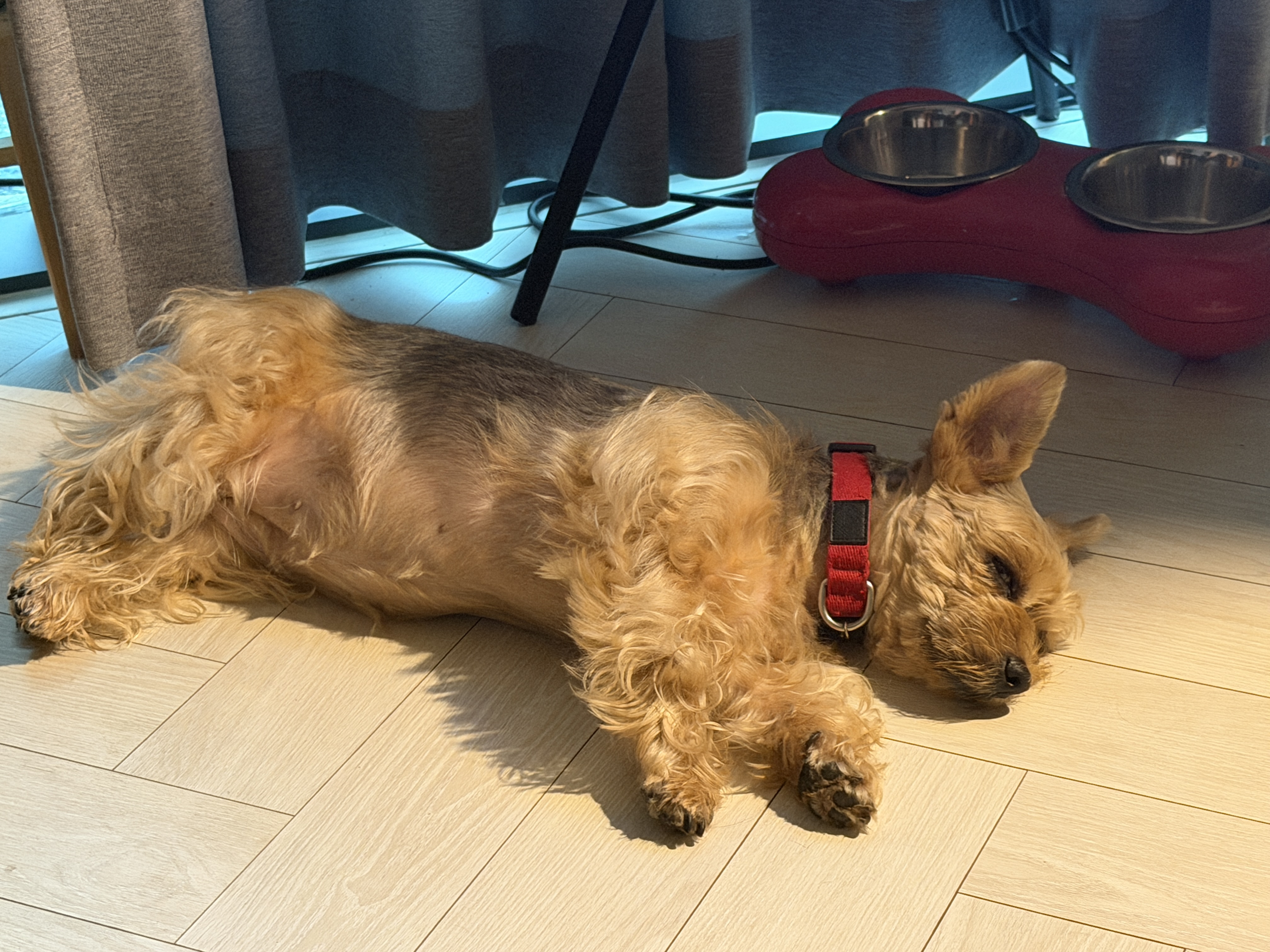
You look over at your dog on the floor and something small snags. She is down again. She was down an hour ago. You start doing arithmetic you have never done before — was it always this much, or is this new? — and then you look for a number to check yourself against. That number is the thing this article is going to take away from you, and give you something better in its place.
Part of our complete guide to caring for a senior dog.
The number you are looking for does not really exist
Search for how long a senior dog should sleep and you will find confident figures. Follow them back toward a source and they tend to dissolve. That absence is annoying, but there is a much more interesting piece of evidence sitting next to it.
In 2023 a team at North Carolina State University published the validation of SNoRE 3.0, an owner-completed questionnaire for measuring sleep in dogs. Building it meant testing which questions actually carried information. Their draft included one asking how frequently the dog napped during the day. It did not load onto either of the factors the analysis found, and it was cut from the final version. The authors' stated reason was that many owners simply are not observing their dogs during the day, and so cannot answer that question accurately.
Sit with that for a second. A validated clinical instrument, built by veterinary sleep researchers, tried to count naps and gave up because the people answering could not do it reliably. If that question is too unreliable for a research tool, the version of it you are running in your head on a Sunday afternoon is not going to be better.
So the honest answer to "how many hours" is that nobody can hand you a threshold, and the reason is not that the science is missing. It is that the question is built wrong.
Lying down is not sleeping
Here is where it gets genuinely surprising. As part of the same validation work, thirty-eight dogs were wired for polysomnography — the full setup with brain activity, eye movement and muscle tone — during a two-hour afternoon nap.
The median dog was awake for about 52% of those two hours. Another 21% was drowsiness, the in-between state where a dog looks settled but is not asleep. Actual non-REM sleep took up around 19%, and REM about 2%. Median sleep efficiency, the share of the recording spent genuinely asleep, was roughly 22%.
A dog can be lying on the floor with her eyes shut for two hours and be truly asleep for well under half an hour of it.
This is the gap that swallows most worry about senior dogs sleeping more. What you are watching is not sleep. It is stillness. An older dog who is less inclined to get up and patrol the kitchen accumulates a lot more stillness in a day without necessarily sleeping a minute longer. When I actually thought about Gomi, I realised what had changed was not that she sleeps more but that she stays down longer between the things that used to move her.
Those are two different observations, and only one of them is about sleep.
What genuinely changes: the shape, not the total
Sleep does change with age in dogs, and the change has a specific character that is much more useful to know than a total.
The clearest picture comes from a 2002 study in Behavioural Brain Research by Takeuchi and Harada, who implanted telemetry devices and recorded brain activity, muscle activity and heart rhythm continuously across a full 24 hours in aged dogs and young dogs. Three findings stand out.
- Daytime deep sleep went up. The older dogs spent significantly more of the daylight hours in slow wave sleep.
- Night-time wakefulness went up. They tended to spend more of the dark hours awake.
- The daytime pattern fragmented. The young dogs showed one clean sleep peak in the early afternoon. The older dogs' daytime sleep broke into scattered peaks instead of a single nap.
REM sleep, which the paper calls paradoxical sleep, dropped sharply in the older group — not only in total time but in the number of episodes, which fell to roughly a third of the young dogs' count overnight. The authors' interpretation was that the aged dogs had lost some of their capacity to sleep through the night, and that the daytime sleeping was compensating for what the night no longer delivered.
One important caveat: this was four dogs in each group, in a laboratory. Treat the direction as informative and the specific percentages as not something to apply to your own dog. But the direction has held up in the years since, and it reframes the whole question. The concerning thing is rarely a bigger total. It is a total that has been redistributed — pulled out of the night and scattered across the day.
Sleeping more and sleeping well are not the same
The instinct is to assume that a dog who is asleep a lot is at least sleeping deeply. The evidence points the other way, and this is the finding that changed how I look at Gomi on the floor.
A 2023 polysomnography study in Frontiers in Veterinary Science recorded twenty-eight senior dogs, aged roughly ten to sixteen, during an afternoon nap and compared their sleep against cognitive testing and a validated dementia questionnaire. Dogs with higher dementia scores spent less time in both non-REM and REM sleep, not more. They also took longer to drop into non-REM in the first place. Dogs who did worse on a problem-solving task showed the same pattern: more time awake, less time asleep, longer to get there.
So the dog who is genuinely in trouble is often not the one racking up hours. She is the one who lies down often, takes a long time to settle, and does not get very deep once she does. From across the room those two dogs look identical.
The same paper is honest about its own limits — the recordings were afternoon naps, not nights, and nobody knows for certain how well that maps onto overnight sleep. But it is enough to retire the idea that more sleep automatically means worse.
What to watch instead of the clock
The questions that survived the SNoRE validation are a good map of what is actually worth noticing, because they are the ones that carried real information. Two of them concern how well she sleeps and two concern what interrupts it.
- How easily she settles at bedtime. Not whether she sleeps, but how long the run-up takes. Longer settling was the measure that correlated most strongly with objective sleep quality.
- Whether she stays down through the night, or surfaces repeatedly. Dogs with worse questionnaire scores were measurably more active between roughly 1 and 3 in the morning.
- Whether she is getting up at night to urinate. A physical reason for waking, and a specific one to report.
- Whether her breathing pauses or changes while she sleeps.
- Whether twitching or vocalising actually wakes her. Dreaming itself is normal — and worth noting, the study found no relationship at all between how much owners thought their dog dreamed and how much REM sleep she was measured to have. The question that matters is whether the movement breaks the sleep, not whether it happens.
One practical note from the authors: because different people judge the same dog differently, whoever does the observing should keep doing it. Consistency in the observer matters more than precision.
The one number you actually can count
There is a number available to you, and it is a better one than hours slept: her breathing rate while she is asleep or fully at rest.
NC State's veterinary cardiology service describes resting or sleeping respiratory rate as a sensitive indicator of how a dog with heart disease is doing, and puts the normal figure at under thirty breaths per minute. Count the rise and fall of her ribs for fifteen seconds and multiply by four.
An important limit on this: in that source, the measure is presented for monitoring dogs who have already had an episode of heart failure, not as a screening test for healthy dogs. Do not use one count to diagnose anything. What it is good for is a baseline. If you know what she runs at while asleep this month, you will know when it has moved — and a number that has moved is worth a phone call, where a vague sense that she seems tired is much harder to act on.
Mitral valve disease is common in ageing small dogs, though only a minority ever progress to heart failure, and many older dogs with it are not limited by it. Early signs owners notice are shortness of breath, tiring easily and coughing. This is precisely the kind of thing that hides underneath "she is just slowing down."
Four things that are not ageing
Sleeping more is not a diagnosis, and the reason to take it seriously is that it is a plausible early face of several treatable things. None of these is sorted out at home.
Thyroid. Lethargy, dullness and reduced activity are among the most commonly reported signs of canine hypothyroidism. AAHA's 2023 endocrinopathy guidance notes that signs are often subtle and progress slowly over months to years — which is exactly how it would look from your sofa. It is diagnosed on bloodwork and it is treatable.
Pain. A dog in discomfort moves less, and moving less looks like resting more. Pain is quieter in dogs than most people expect, and the signs are frequently read as ordinary ageing. We covered what those signs actually look like separately, and it pairs directly with this one.
Heart. As above. Tiring quickly, breathlessness and cough are the early ones, and a resting breathing rate that has crept up is the measurable version.
Cognitive change. Disruption of the sleep-wake cycle is one of the defining features of canine cognitive dysfunction, and it usually comes with company — disorientation, changed interaction, accidents indoors. If night waking is accompanied by pacing, staring, or getting stuck in corners, that pattern has its own article. Also worth knowing: night-time accidents are more often a urinary or kidney matter than a cognitive one, so they get investigated in that order.
What this looked like with Gomi
Gomi is eleven. She naps more than she did, she does not seem to sleep deeply, and she wakes at some point most nights. She has two beds, one in the bedroom and one in the living room, and she moves between them on her own in the dark. She sleeps longest in the living room, which is where I usually am.
The thing I nearly logged as a warning sign was this: if I get up and move around at night, she sits bolt upright, instantly, every time.
Then I remembered she has done that since she was a puppy.
That is the whole difficulty of this topic in one behaviour. Once you start watching an older dog for signs, everything she does starts looking like one, including the things she has always done. The only defence is knowing what her normal was — which is why writing anything down at all beats trying to hold eleven years of baseline in your head.
There is also decent evidence that where a dog sleeps affects how well she sleeps. A 2025 polysomnography study found dogs slept more efficiently, dropped off faster and got more deep sleep with their owner in the room than with a friendly stranger. The authors were careful to say the recording happened in an unfamiliar laboratory and so should not be turned into advice about home sleeping arrangements, and I will respect that. The general point still stands: if you have recently changed where your dog sleeps, that alone can shift her pattern enough to look like something medical. Mention it, so it gets read correctly.
For what it is worth, Gomi gets checked every six months and nothing has turned up. I am not writing this from worry. I am writing it because I spent a while trying to count her hours before working out that the count was never going to tell me anything.
What to actually do this week
Pick a quiet evening and count her sleeping breathing rate. Write the number down. Note roughly how long she takes to settle, and whether she was up in the night. Do that a handful of times over a couple of weeks and you will have something a vet can use, which is more than an impression ever is.
Our free Tiny Changes checklist has room for this kind of note, and the 90-day journal gives it a daily line — mostly useful because it converts "she seems to be sleeping more" into something you can look back at. If her energy has dropped alongside a change in what she is eating, the nutrition side is worth a look too.
Frequently asked questions
How many hours should a senior dog sleep?
There is no dependable target. The most telling evidence is that when researchers validated the SNoRE 3.0 sleep questionnaire, the question asking owners how often their dog napped in the daytime was dropped, because owners who are not watching their dogs all day cannot answer it accurately. Watch the shape of her sleep instead of the total.
Why is my old dog restless at night but sleepy all day?
This is the most consistent age-related finding. A 24-hour recording study found older dogs spent significantly more daytime in deep sleep, tended toward more night wakefulness, and lost the single clean afternoon nap the young dogs had. The authors read the daytime sleep as compensation for a night that no longer holds. The study was small, so take the direction and not the percentages — and mention night restlessness to your vet, since pain, cognition and needing to urinate all cause it.
Is my dog really asleep, or just lying there?
Frequently the latter. Thirty-eight dogs recorded during a two-hour afternoon nap were awake for a median 52% of it, with sleep efficiency around 22%. Stillness accumulates much faster than sleep does, which is why the impression of "sleeping more" so often outruns the reality.
What breathing rate is normal for a sleeping dog?
NC State's cardiology service puts a normal resting or sleeping rate at under thirty breaths per minute. That figure is used for monitoring dogs with known heart disease rather than screening healthy ones, so use it to establish your dog's baseline rather than to draw a conclusion. A rate that has changed from her own normal is the thing worth reporting.
When should I take her to the vet about it?
Soon, if anything else has changed with it — appetite, weight, breathing, thirst, toileting, or how she interacts with you. Same day, if it came on over hours or days rather than months. Thyroid disease, pain, heart disease and cognitive change can all look like an old dog resting more, and the first three are treatable.